
Table of Contents
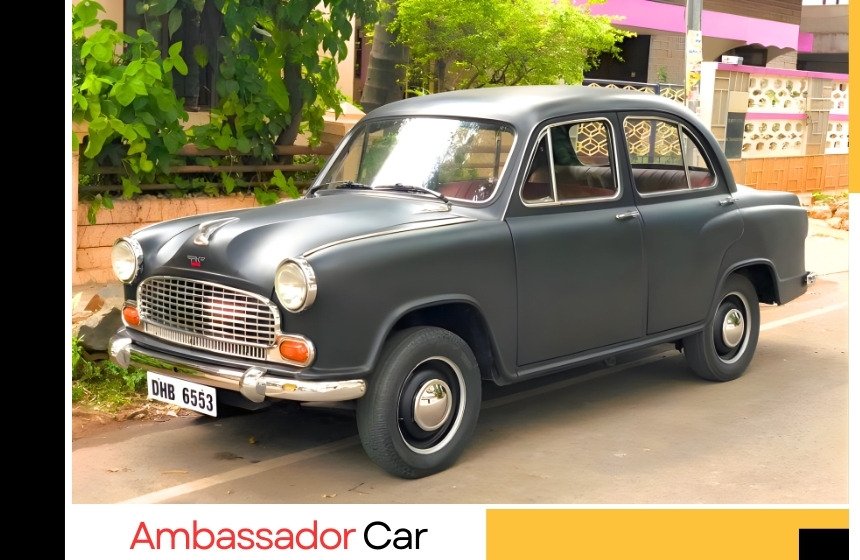
Ambassador car commonly referred to as Hindustan Ambassador is not an ordinary automobile in India. It is a period of simplicity, permanence and trust. This car dominated Indian roads over decades being the favorite among government officials, taxi operators and even families. The Ambassador was a man of the people; in urban streets and rural byways alike, the word dependability was associated with the Ambassador. It did not continue production in 2014 though the legacy and presence of the company are still solid even in 2026, particularly in the used-car market.
This article will Provide complete information about Ambassador Car price, variants, features, specifications and more.
Hindustan Motors: Company Overview
Hindustan Motors was established in 1942 at Kolkata and was one of the first automobile producers in India. The company was instrumental in setting up the domestic production of vehicles at a time when India had a small production capacity in terms of industrial capacity. Hindustan motors introduced the Ambassador in 1957 on a license of the Morris Oxford Series III.
The automobile was designed to operate in the problematic roads, poor fuel choices, and the high traffic of India. The Ambassador changed over the years to have diesel engines, better interiors and slight design enhancements, yet its fundamental essence remained the same. It almost had a monopoly status over the decades particularly prior to liberalization of economies in the 1990s. But with the introduction of modern cars that are fuel efficient, demand started falling. It was eventually discontinued in production in 2014 and the Ambassador brand was acquired by Groupe PSA in 2017.

| Aspect | Details |
| Founded | 1942 |
| Headquarters | Kolkata, India |
| Iconic Model | Hindustan Ambassador |
| Production Years | 1957–2014 |
| Manufacturing Plant | Uttarpara, West Bengal |
| Peak Production | 30,000+ units annually |
| Brand Sale | Sold to Groupe PSA in 2017 |
| Market Role | Government, taxi, family car |
Ambassador Car Price and Variants
In 2014, the legendary ambassador of Hindustan Motors was discontinued. The Ambassador was sold in petrol, diesel, and CNG versions before its retirement, with the ex-showroom prices in India varying between 4.21 lakh and 6.40 lakh. CNG versions were the cheapest, petrol were middle priced and diesel versions, especially the high-end models were the costliest. Periodic reports also exist regarding a potential future product known as an Ambassador 2.0 or electric revival, which is projected to be around 2026 priced approximately ₹10 to ₹15 lakh.
| Fuel Type | Variant Name | Engine (cc) | Price (₹ Lakh) |
| Petrol | Ambassador Classic Nova Petrol | 1817 | 4.47 |
| Petrol | Ambassador Classic 1800 ISZ MPFI | 1817 | 4.47 |
| Petrol | Ambassador Classic 1800 ISZ MPFI PS | 1817 | 4.62 |
| Petrol | Ambassador Grand 1800 ISZ MPFI | 1817 | 4.88 |
| Petrol | Ambassador Avigo 1800 ISZ MPFI AC | 1817 | 5.54 |
| Diesel | Ambassador Classic 1500 DSL | 1489 | 4.65 |
| Diesel | Ambassador Classic Nova Diesel | 1489 | 4.65 |
| Diesel | Ambassador Encore BSIV | 1489 | 4.98 |
| Diesel | Ambassador Avigo 2000 DSZ | 1995 | 6.04 |
| Diesel | Ambassador Grand 2000 DSZ PW CL (Top Model) | 1995 | 6.40 |
| CNG | Ambassador Classic 1800 ISZ CNG | 1817 | 4.21 |
| CNG | Ambassador Grand 1800 ISZ MPFI PW CL CNG | 1817 | 5.20 |
Ambassador On Road Price (City Wise Data)
Ambassador car Prices on-country differ widely based on the taxes of the state roads, registration fees and insurance. The costs are often more expensive in Metro cities as the regulations and RTO fees are more strict.
| City | Petrol Classic | Diesel Variant | Notes |
| Delhi | ₹3.5 lakh | ₹6 lakh | Higher road tax, diesel restrictions |
| Mumbai | ₹3.8 lakh | ₹6.5 lakh | Higher insurance and VAT |
| Bangalore | ₹3.6 lakh | ₹6.2 lakh | Lifetime tax system |
| Kolkata | ₹3.2 lakh | ₹5.8 lakh | Lower legacy vehicle taxes |
Ambassador Top Speed, Engine & Performance
The Hindustan ambassador was never created to be fast. It focused on durability, torque and long-distance usability. It has been available over the years in petrol, diesel and in CNG versions. The petrol models had a 1.8-litre engine that had reasonable power to travel in the city and the highway. Diesel models, which use engines made by Isuzu, became highly successful with the taxi operators with their fuel economy and durability.
| Variant | Engine | Power & Torque | Top Speed | 0–100 km/h |
| Petrol | 1.8L OHV | 75 PS / 130 Nm | 120 km/h | ~30 seconds |
| Diesel | 1.7L Isuzu | 57 PS / 105 Nm | 140 km/h | ~25 seconds |
| CNG | 1.8L | 65 PS / 120 Nm | 110 km/h | ~32 seconds |
It was a stable performance as opposed to an exciting one. The Ambassador was comfortable and strong with heavy loads and stable on highways, though to overtake, one would have to plan ahead.
Ambassador Car Mileage & Fuel Economy
The Ambassador never had the greatest selling power on fuel efficiency, but in its weight and time, the figures were good, particularly in diesel. Older engine technology and petrol type is not economical in terms of daily city utilisation. The diesel models on the other hand became widespread among taxi operators as these offered them better mileage and less running expenses over great distances. CNG conversions also lowered fuel costs, although performance was hit significantly. Proper tuning, regular servicing and moderate driving habits contribute significantly to the eliciting of decent mileage out of the ambassador.
| Fuel Type | City Mileage | Highway Mileage | Remarks |
| Petrol | 8–10 kmpl | 12–15 kmpl | Higher fuel consumption |
| Diesel | 12–14 kmpl | 14–16 kmpl | Most economical option |
| CNG | 10–12 km/kg | 11–13 km/kg | Lower running cost, less power |
Off-Road Hardware & Capability
Even though the Ambassador was not a four-wheel-drives car, it was quite competent on the Indian bad and uneven roads. Its heavy body-on-frame construction, large suspension system, and high ground clearance enabled it to go through potholes, mud, gravel and even waterlogged streets with ease. This especially was popular in rural and semi urban areas where the conditions of roads were not predictable. Although it did not have any modern traction aids or four wheel drive, its mechanical durability made up for the shortcomings.
| Component | Specification | Benefit |
| Chassis | Body-on-frame | High durability |
| Suspension (Front) | Torsion bar | Smooth over bumps |
| Suspension (Rear) | Leaf springs | Handles heavy loads |
| Ground Clearance | ~152 mm | Suitable for rough roads |
Hindustan Ambassador Interior & Features
The design of the inside of the Ambassador was based on comfort, space and practicality as opposed to luxury. Its high roof, broad seating and flat floor made it very comfortable on long routes and suitable for carrying passengers. Exiting and entering was very easy because of broad-opening doors. As the years went by, the car was also given simple upgrades like air conditioning, better dashboards, power steering among others and the cabin had a basic and functional nature in the course of its existence. The big boot also made it more practical to both the family and commercial end-users.
| Feature Area | Details |
| Seating Capacity | 5–7 passengers |
| Seating Type | Wide bench seats |
| Comfort Add-ons | AC, power steering (later models) |
| Instrument Cluster | Analog dials |
| Boot Space | Approx. 300 litres |
Ambassador Exterior Design Highlights
The exterior design of the Ambassador did not change much over decades, thus, becoming its greatest identity. Its cubical shape, curved edges, accented grille by chrome and round-shaped headlights made it an immediate identification in Indian roads. New editions of the car over various years consisted of a few small updates, such as more updated bumpers, but the classic shape remained. Its design provided good road presence but was not too wide as to be difficult to fit in tight streets.
| Design Element | Description |
| Body Shape | Boxy, upright |
| Headlamps | Round, classic design |
| Grille | Chrome-finished |
| Road Presence | Strong and commanding |
| Design Evolution | Minimal changes over decades |
Hindustan Ambassador Safety Features
The safety equipment of the Ambassador was primitive. Majority of the versions had disc brakes in the front and drum brakes in the rear. The package never included the advanced safety technologies of ABS, airbags, or the electronic aids. Nevertheless, the body of the car, made of heavy-gauge metal and solid, provided some passive safety that several of its owners felt confident in. The use of seatbelts was later made normal in the later years after the update on the regulations.
| Safety Aspect | Availability |
| Front Brakes | Disc |
| Rear Brakes | Drum |
| ABS | Not available |
| Airbags | Not available |
| Seatbelts | Standard in later models |
Ride & Handling
Among other things, the Ambassador had a very comfortable ride. The suspension was designed to absorb the rough surfaces with ease and therefore made it easy to make long distance journeys even on bad roads. This low arrangement, however, made the body roll in the corners evident. There was a lot of insecure driving going on at such speed because the car was not aimed at aggressive moves. The steering was light and easily controlled, although the huge turning circle was more evident in the tight areas.
| Aspect | Character |
| Ride Quality | Very comfortable |
| Suspension Tuning | Soft |
| Handling | Stable but not sporty |
| Body Roll | Noticeable |
| Steering | Light, large turning radius |
Hindustan Ambassador Competitor Comparison
The Hindustan Ambassador will mostly be competing with the rugged and utility-oriented cars in the 2026 used-car market, with some modern compact SUVs. It is not the competition with new age cars in terms of features and efficiency, but it still can be valued by the purchaser who appreciates the durability, ease of repair, and legacy. The following is a brief and simplifed comparison table of the points of difference.
| Vehicle | Price Range | Mileage | Ground Clearance | Seating | Core Strength |
| Hindustan Ambassador | ₹3–7 lakh | 10–15 kmpl | 152 mm | 5–6 | Iconic, low-cost maintenance |
| Mahindra Bolero | ₹6–10 lakh | 14–16 kmpl | 180 mm | 7–9 | Rugged utility, diesel torque |
| Maruti Gypsy | ₹4–8 lakh | 10–12 kmpl | 205 mm | 6–8 | Light 4×4, off-road capable |
| Tata Punch | ₹6–12 lakh | 18–20 kmpl | 187 mm | 5 | Modern features, safety |
Ownership Cost & Maintenance
Low cost of maintenance is one of the greatest virtues of having an Ambassador. There are high supplies of spare parts that are cheap. The monthly service fee falls within 1000 to 2000. Insurance is cheap and variants that use diesel have higher resale value. An Ambassador can be easily found to last beyond 10 years today with proper care.
Conclusion
Even decades after the Hindustan ambassador was discontinued, the car is a one time model in the Indian automobile market. It is not a vehicle that is competing under the current condition as per its high safety, fuel economy or technology. Rather, it is characterized by good quality of its builds, unsurpassed ride ability on poor roads, spacious interior, and very low maintenance expenses. All these attributes ensure that it remains useful in certain parts of the used car market by 2026. Compared to the competition like Mahindra Bolero, Maruti Gypsy or the newer model Tata Punch, the Ambassador might suffer in terms of performance and functionality, but it can provide what many of its competitors lack and that is, simplicity and durability.
FAQs
Yes, but only in the used-car market, as production stopped in 2014.
The diesel Ambassador Grand is considered the best due to better mileage and durability.
It can be used daily, especially in rural or semi-urban areas, but it lacks modern comfort and safety features.
Yes, spare parts are widely available and inexpensive across most parts of India.
Have any thoughts?
Share your reaction or leave a quick response — we’d love to hear what you think!
-
 0
0
-
 0
0
-
 0
0
-
 0
0
-
 0
0
-
 0
0