
Table of Contents
Key Takeaways
- Traditional firewalls are becoming less effective against advanced cyber threats.
- Integration of AI and machine learning enhances firewall capabilities.
- Adaptive firewalls offer real-time protection by dynamically updating security protocols.
Table of Contents
- Limitations of Traditional Firewalls
- Integration of AI and Machine Learning
- Adaptive Firewalls for Real-Time Protection
- Enhancing Threat Detection with AI
- The Role of Zero-Trust Security
- Future Trends in Firewall Technology
- Conclusion
In today’s rapidly shifting digital world, cybercriminals have devised increasingly innovative ways to exploit network vulnerabilities. While conventional firewalls were once the cornerstone of secure networks, their static approaches frequently fall short against today’s sophisticated attackers. Organizations now rely on more advanced solutions, such as NGFW firewall solutions, to meet modern security demands in a landscape where threats evolve continuously. Adopting firewalls is crucial for protecting sensitive data and maintaining business continuity. New generations of firewalls leverage technologies such as artificial intelligence, machine learning, and automation to deliver far greater defense than was previously possible. This shift is not just a technical change; it is a fundamental strategy that aligns with broader cybersecurity approaches being adopted around the globe. As enterprises migrate to the cloud, deploy remote workforces, and handle more encrypted traffic than ever, legacy firewalls can create significant visibility gaps. A modern approach ensures flexible deployment options and more effective responses to unknown or targeted threats.
Limitations of Traditional Firewalls
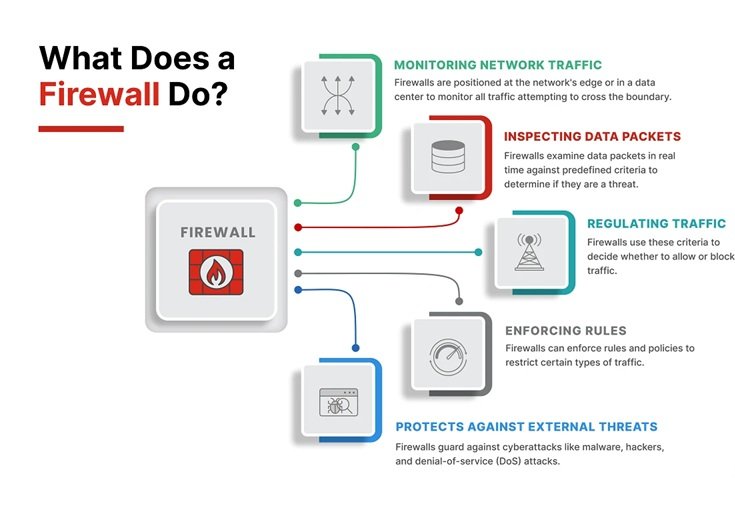
Traditional firewalls operate on predetermined security rules, monitoring what enters and exits a network. However, their effectiveness has diminished as attack methods have grown more complex. Modern attackers often leverage cloud services, encrypted traffic, and sophisticated tactics that old systems cannot readily parse or intercept. Key limitations include:
- Cloud Visibility: Difficulty in monitoring data across cloud environments, leaving gaps that attackers can exploit.
- Encrypted Traffic: Traditional firewalls may be unable to inspect encrypted sessions without degrading performance or missing malicious payloads entirely.
- Advanced Threats: Static rulesets cannot adequately recognize or respond to zero-day exploits, AI-driven malware, or evolving multi-stage attacks.
These shortcomings make it clear that static defenses are obsolete in today’s risk environment. Modern security postures require tools that are context-aware and adaptive.
Integration of AI and Machine Learning
By embedding artificial intelligence and machine learning in firewall technologies, organizations now enjoy powerful new capabilities. Modern firewalls equipped with AI can analyze vast swathes of network traffic, learn behavioral baselines, and identify anomalies far more accurately and quickly than human operators alone.

- Analyze Network Traffic: AI continuously scans for abnormal data flows and correlates events, even as threats morph to bypass typical detection systems.
- Automate Responses: Automated playbooks enable an immediate, policy-based reaction to suspicious activities, reducing both manual workloads and incident response timeframes.
- Predict Threats: With access to threat intelligence and historical data, AI can forecast potential attacks, enabling teams to harden their networks preemptively.
This evolution has transformed firewalls from passive gatekeepers into active sentinels that dynamically shield organizations from both known and emerging risks. As CSO Online highlights, staying ahead requires embracing these newer technologies.
Adaptive Firewalls for Real-Time Protection
A defining feature of next-generation firewalls is their ability to adopt adaptive strategies. Unlike their static ancestors, adaptive firewalls rapidly learn from new information and react on the fly. This flexibility is vital for environments dealing with constantly shifting attacker tactics.
- Continuously Learn: These firewalls update their threat intelligence databases with inputs from multiple sources, including global feeds and on-network behaviors.
- Respond in Real-Time: As soon as a threat is recognized, rules and inspection engines are updated instantly to block malicious traffic or isolate affected segments.
- Reduce False Positives: Machine learning refines detection patterns, limiting interruptions from benign activities while ensuring true threats are not missed.
Enhancing Threat Detection with AI
Artificial intelligence is now indispensable for uncovering stealthy threats that evade conventional detection. Today’s intelligent firewalls operate at network speeds, reviewing billions of data points for clues of compromise.
- Identifying Anomalies: Unexpected spikes, erratic port activity, or lateral movement attempts can trigger instant alarms.
- Processing Large Data Sets: AI excels at cross-correlating data from endpoints, servers, and cloud applications, accelerating discovery of coordinated attacks.
- Improving Accuracy: Continuous refinement reduces both false positives and missed genuine threats, making SOC reports more actionable and less burdensome.
The rapid pace and accuracy of AI in identifying advanced threats make it a core requirement for all modern firewall deployments.
The Role of Zero-Trust Security
Zero-trust security frameworks have become an industry best practice, built on the principle that no entity should be trusted by default, whether inside or outside the network perimeter. Next-generation firewalls play a pivotal role within these architectures. Key elements include:
- Authenticate Every Access Request: Every user, device, and application must prove its identity before gaining access to sensitive resources.
- Monitor Continuous Activity: Firewalls audit ongoing sessions, terminating access if suspicious behavior is detected at any time.
- Limit Access: Permissions are granted only as needed, minimizing potential damage from compromised credentials or insider threats.
By weaving firewalls into zero-trust architectures, organizations enforce strong security policies while keeping agility for business operations.
Future Trends in Firewall Technology
As networks grow more complex and attackers adopt new tools, firewall technology continues to evolve rapidly. Prominent emerging trends include:
- Quantum-Resistant Encryption: Anticipating the potential of quantum computers to break current cryptographic methods, firewalls are being upgraded for quantum-safe protocols.
- Integration with AI Red-Teaming: Simulated attacks driven by AI assist in identifying weaknesses and stress-testing defenses regularly.
- Enhanced Cloud Security: Firewalls are increasingly tailored to protect cloud-native environments, addressing security around containers, serverless functions, and multi-cloud deployments.
These and other technical advances will ensure that organizations are better prepared for the future, keeping one step ahead of an ever-evolving threat landscape.
Conclusion
Cybersecurity threats are growing in scale and complexity every year. Relying on conventional, perimeter-based firewalls is no longer sufficient to maintain secure networks. Integrating AI and machine learning, deploying adaptive solutions, and aligning with zero-trust models are now foundational for every organization’s security strategy. By keeping abreast of future developments and best practices, companies can safeguard their data, reputation, and operations against even the most sophisticated adversaries.
Have any thoughts?
Share your reaction or leave a quick response — we’d love to hear what you think!
-
 0
0
-
 0
0
-
 0
0
-
 0
0
-
 0
0
-
 0
0