
Table of Contents
Australia’s building landscape is at the crossroads of great change. With the introduction of the National Construction Code and the demand for energy efficiency from clients, the concept of “green building” is not longer a niche market, but the way of the future. Builders who do not change with the times and embrace the new low-carbon future will soon find themselves lagging behind the competition.
What does it mean to be sustainable these days? Is it solar panels and rainwater tanks? Not anymore. Today, it is all about the materials. Today, it is all about the materials. Minimising a building’s carbon footprint begins before a brick is ever laid, with the selection of raw materials. If you are a builder who wishes to remain competitive in the market, it is essential that you are aware of these new material trends and partner with certified sealant product distributors and the like.
Mass Timber and Engineered Wood
Although timber framing has been in existence in Australia in the construction of homes, mass timber is proving to be revolutionary in the construction of commercial buildings. It is referred to as CLT (Cross Laminated Timber) and Glulam (Glued Laminated Timber). It is stronger than steel and concrete, yet possesses only a fraction of their weight.
The advantages of employing mass timber in the construction of buildings lie in its speed of construction, as the panels are assembled extremely quickly. It is also beneficial because timber is a carbon sink, locking up carbon in the structure of the building. This is proving to be an advantage in selling the product to customers who are concerned about their footprint on the environment. It is being employed in the construction of mid-rise buildings in Australia in an effort to achieve high sustainability ratings.

Incorporating Bio-Based Materials
The construction industry in Australia is also benefiting from the innovations in the usage of agricultural by-products in the form of bio-based materials. Bio-based materials are derived from plant matter, fully biodegradable, or recyclable at the end of their useful life. Among these materials, hempcrete has been found to be the most promising in Australia.
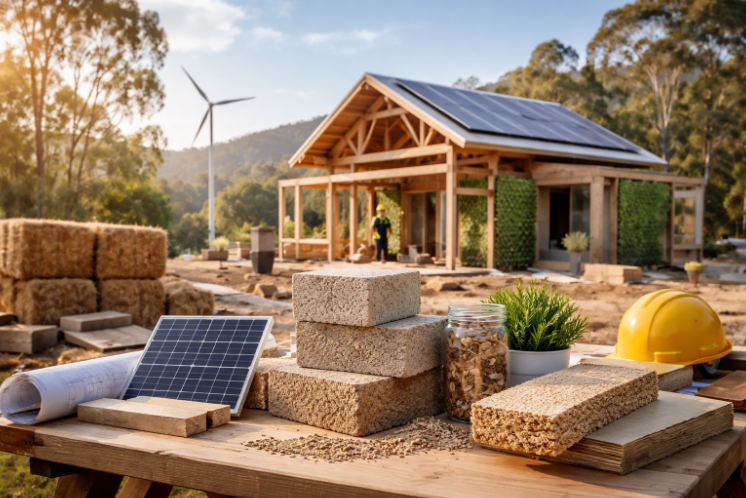
Hempcrete is made from the woody part of the hemp plant and lime. Hempcrete is a very good insulator. It also regulates moisture. In addition, hempcrete prevents mould growth, a problem in coastal areas. Currently, hempcrete is only used in non-structural elements, although its usage is being researched. Straw bales and mycelium, or mushroom root, are also bio-based building materials that are slowly being introduced into the market, transitioning from the research phase to bespoke residential building projects.
Recycled and Reclaimed Resources
The concept of a circular economy has revolutionised how resources are used. The traditional concept of waste is now being changed to how resources are being recycled. Waste is now being recycled instead of going to landfills. We are not just talking about recycling bricks that were once used in construction. We are also referring to new technologies that allow us to manufacture building materials from waste. This means recycled plastics used in road base, railway sleepers, and bricks. We are also seeing recycled steel used in construction, a material that many structural engineers are now specifying. By specifying materials that contain a high amount of recycled material, we can not only reduce our impact on our environment, we can also save money.
The Future of Australian Building
This is not a fad. The regulations that require net-zero emissions in building projects will only get tougher. For builders, this is a chance to be leaders in this new market for building materials. There is a wide variety of materials that we can now use in building. We now have low-carbon concrete, mass timber, bio-based building materials, and recycled building materials. The earlier we adopt these new building materials, the better for our future!
Have any thoughts?
Share your reaction or leave a quick response — we’d love to hear what you think!
-
 0
0
-
 0
0
-
 0
0
-
 0
0
-
 0
0
-
 0
0